Manage titles and approve audience levels
If you manage titles at the district level, you can view a title's details, see its location, edit its title, add a title tag, filter titles by classroom, and set an audience level. You can set audience levels individually and push them to all classroom libraries in the district.
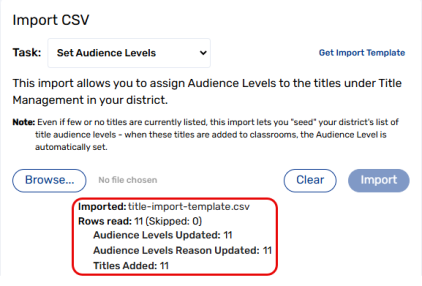
If you already have a list of titles with audience levels, you can import it via a CSV file. When these titles are added to classrooms, the audience level is automatically set.
|
Notes:
|
To manage audience levels for titles:
- Log in to Destiny as a district-level administrator.
- From the primary navigation bar, select
 > Classroom Library. The Classroom Directory page appears.
 - From the sidebar, click Title Management.
Note: The Title Management page appears only if you enable it. To do so:
- From the sidebar, click Settings.
- Select Enable district management of classroom titles.
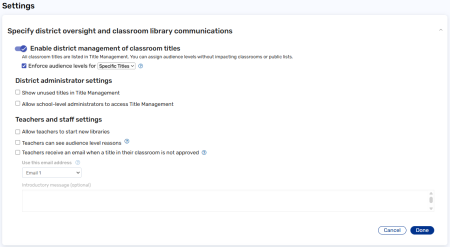
- Click Done.
- From the Title Management page, do any of the following:
If you want to... Then... View title details (in Titlewave®) Do one of the following:
- Next to the desired title, click
 .
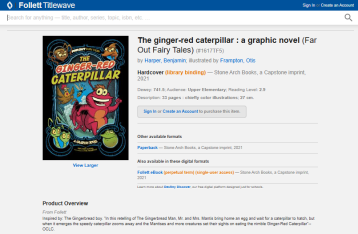
. - Click a title. From the pop-up, click the title or .
Titlewave opens to the title details page.
Notes:
- The icon appears next to all titles with an ISBN. If a title's details are unavailable in Titlewave, a message lets you know no Titlewave matches were found.
- If you edit a title, the connection to Titlewave will remain, regardless of any changes you make to the title's information.
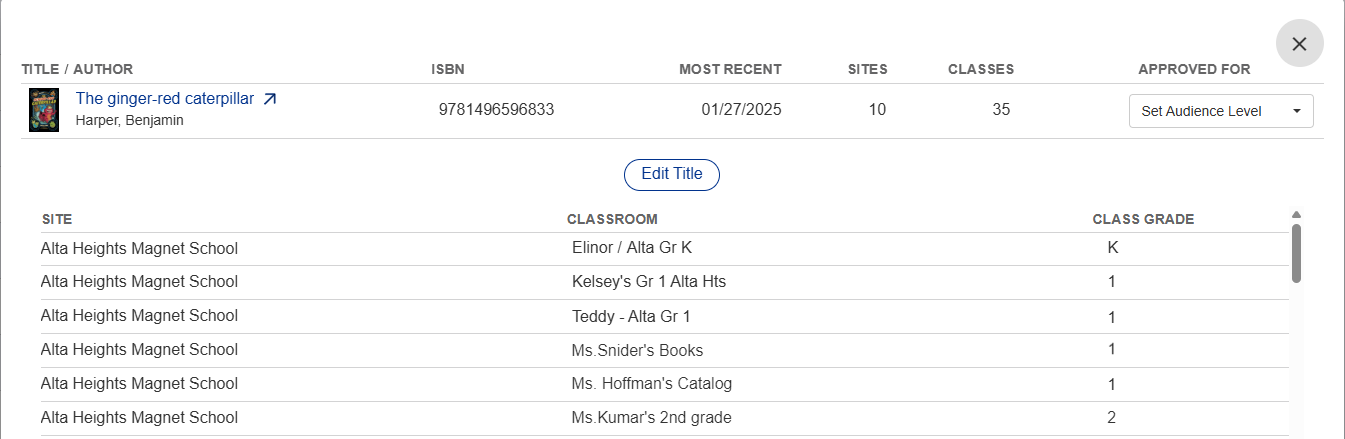
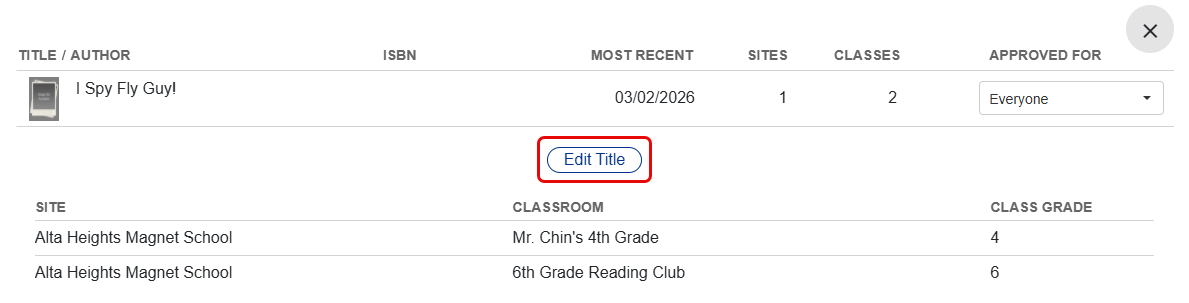
View a book's location Click a title. Details of the book's location – including the school, classroom, and class grade – appear.
Edit a title - Click a title.
- From the pop-up, click Edit Title.
A pop-up appears.
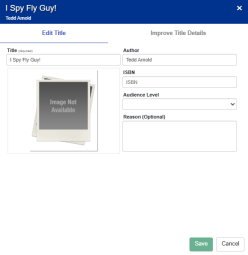
- Do one of the following:
- From the Edit Title tab:
- Enter or edit the desired information in the fields.
Note: You can select an audience level for a title, and add a reason (optional).
- Click Save.
- Enter or edit the desired information in the fields.
- From the Improve Title Details tab:
- Select the desired cover image, or click This!.

Notes:
- Click
 to view a title's details, such as classification, reading level, and interest level.
 - A title's details and cover image come from Titlewave.
- Click
- Click Update Info.
- Click Save.
- Select the desired cover image, or click This!.
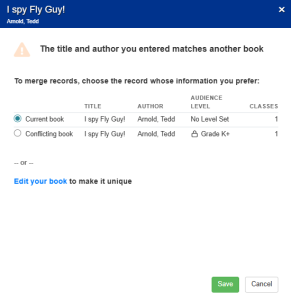
Note: If your changes result in a duplicate title record, you can merge titles. From the pop-up that appears, select the record you want to keep, and then click Save.
- From the Edit Title tab:
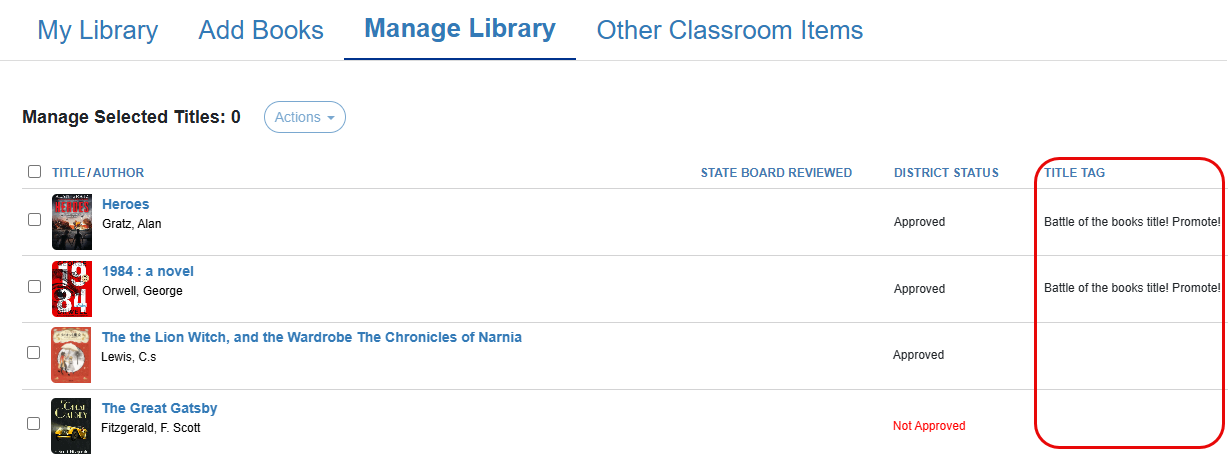
Add a title tag - Click a title.
- From the pop-up, click Edit Title.

A pop-up appears.
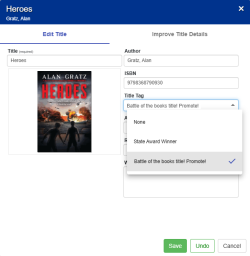
- From the Title Tag drop-down, select the desired tag.
- Click Save.
Notes:
- Deleting a tag on the Settings page removes it from all titles.
- Teachers can view any tags you assign on the Manage Library tab.
Delete a title - Click a title. A pop-up appears.
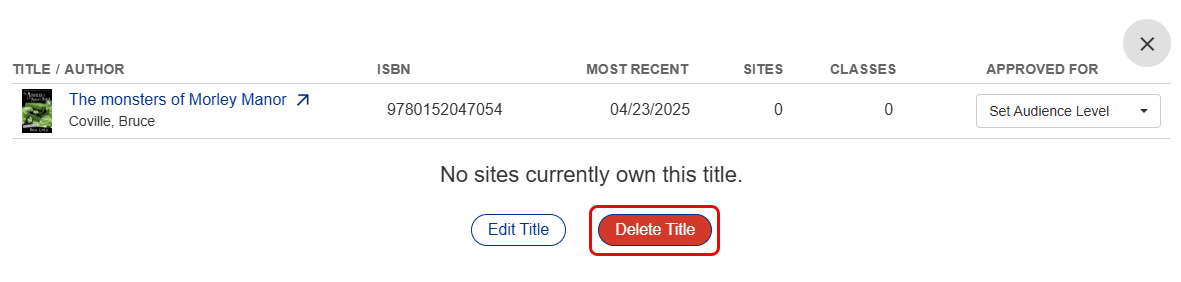
- Click Delete Title.
Note: You can only delete unused titles.
Enter a title, author, or ISBN in the field. A list of search results appears.
Notes:
- When searching by title or author, you can omit punctuation. For example, 'babysitters club' instead of 'baby-sitters club' or 'jk rowling' instead of 'j.k. rowling'.
- You can search for titles with 10-digit or 13-digit ISBNs. Titles with 10-digit ISBNs are automatically converted.
- Search results remain until you click
 or enter another search term in the field.
- Click
 .
. - Do either of the following:
- To find records that might be duplicates, select the View Potential Duplicate Titles checkbox.
Note: When you select this option, all other filters will be disabled. To restore your previous filters, deselect the checkbox.
- To filter by Date Added, Approved For Audience Level, Interest Level, Site, or Incomplete Titles, click
 next to the filter you want.
Notes:
- To see all titles in a specific classroom library, next to the site name, click . Then, select the checkboxes for the desired classrooms.
- The Incomplete Titles filter lets you find records missing an ISBN, an author, or both.
- To see all titles in a specific classroom library, next to the site name, click
- To find records that might be duplicates, select the View Potential Duplicate Titles checkbox.
Export titles
Click Export. The CSV file downloads to your browser's Downloads folder.
Notes:
- To export a specific list of titles, select the checkboxes next to the titles you want to include. Then, click Export.
- Exported information includes title, author, ISBN, date added, audience level, audience level reason and description, site, classroom name, and class grade.
Sort titles by date
In the MOST RECENT column, click the drop-down to change the sort order.
Set an audience level for one or more titles and add a reason (optional)
Note: When you set an audience level (and reason) for a specific title, you are assigning it to every copy in your district. The SITES and CLASSES columns show you the number of schools and classrooms with that title.
Do one of the following:
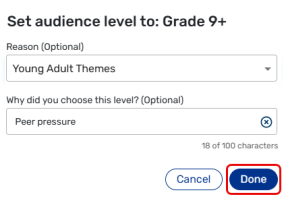
- To set the audience level for a single title, in the APPROVED FOR column, select an option from the drop-down.
- From the pop-up, select a reason (optional) from the drop-down.
- Type a description (optional) in the field.
- Click Done.
- To set the audience level for multiple titles, select the checkboxes next to the desired titles, and then click Set Audience Levels.
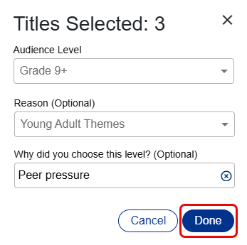
- From the pop-up, use the Audience Level drop-down to select a grade level.
- Use the Reason (optional) drop-down to select a reason.
- Type a description (optional) in the field.
- Click Done.
- Next to the desired title, click
To push audience levels to the district:
After you assign audience levels to your titles, you can enforce them by pushing them to all classroom libraries in the district. Teachers can see which titles have not been approved for their classroom.
You can set approval levels for all titles or only specific ones. If you choose all titles, then any new title a teacher adds to their library is automatically assigned a Pending status until an audience level is set by the district. If you only want to set levels for specific titles, then any new title a teacher adds to their library is automatically approved for everyone unless you change its level.
Titles without a level are not visible to students. Students can only see titles with a level that is equal to or lower than their primary grade.
|
Notes:
|
 in the primary navigation bar. Click the notification to go directly to the Title Management page to set the audience level. Any title without an audience level appears.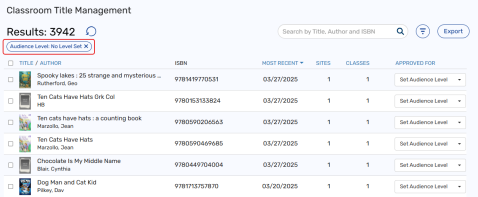
 in the primary navigation bar.
|
Important: If the Enforce audience levels for checkbox is deselected and Enable district management of classroom titles is selected, district-level administrators can set audience levels without pushing them to the district. |
- Log in to Destiny as a district-level administrator.
- From the primary navigation bar, select > Classroom Library. The Classroom Directory page appears.
- From the sidebar, click Settings.
- Select the Enforce audience levels for checkbox.
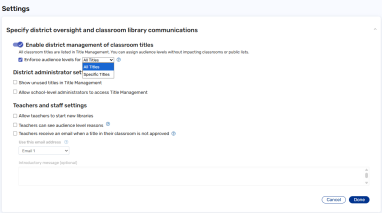
- From the drop-down, select one of the following:
- All Titles: Assign audience levels to all titles in the district. Titles added to classroom libraries are automatically pending until you set an audience level.
- Specific Titles: Assign audience levels to only specific titles in the district. Titles added to classroom libraries are automatically approved unless you change an audience level.
- Click Done.
To add multiple audience levels via a CSV file:
- Log in to Destiny as a district-level administrator.
- From the primary navigation bar, select > Classroom Library. The Classroom Directory page appears.
- From the sidebar, click Settings.
- In the Import classrooms, titles, and audience levels row, click
 .
. - From the Task drop-down, select Set Audience Levels.
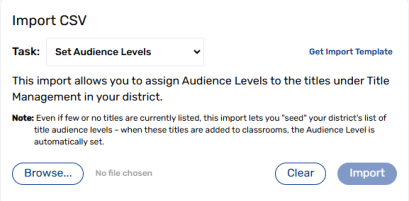
Notes:
- If you need an import template for your audience levels, click Get Import Template. From the pop-up that appears, click Download Template. The template downloads to your browser.
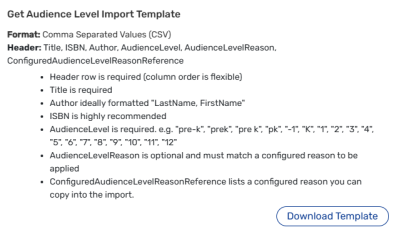
- You cannot create a new audience-level reason during an import. New reasons must be added on the Settings page before importing the file.
- If you need an import template for your audience levels, click Get Import Template. From the pop-up that appears, click Download Template. The template downloads to your browser.
- Click Browse, and then select the desired CSV file from your computer.
- Click Import. The number of audience levels updated appears.